Can Downsizing in Retirement Actually Cost More?
Direct answer
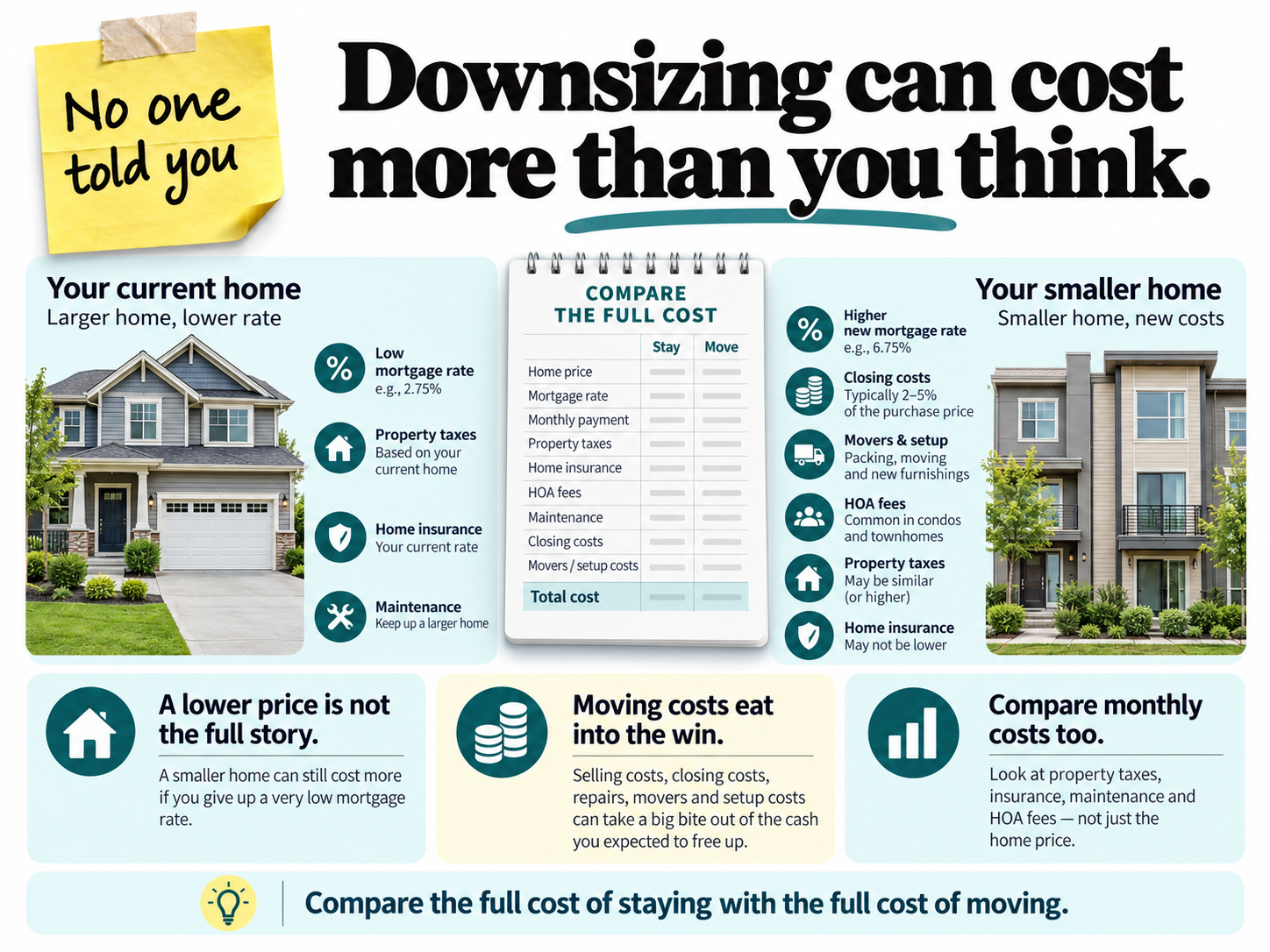
Yes. A smaller or cheaper home can still cost more if you give up a low mortgage rate, pay large closing and moving costs, add HOA fees, or move somewhere with higher property taxes or insurance. Compare the full cost of staying with the full cost of moving, not just the two home prices.
Updated
The short version
“Just downsize.”
It sounds like obvious retirement advice.
Sell the big house.
Buy something smaller.
Free up money.
Lower your bills.
Sometimes that works.
Sometimes the smaller house costs more.
Your mortgage rate matters
If you have an older low-rate mortgage, moving means giving it up.
The replacement house may cost less.
But if you need a new mortgage at a much higher rate, the monthly payment may not drop nearly as much as you expect.
That old mortgage rate has value.
You cannot see that by comparing home prices.
Moving costs money before you save anything
You may pay for:
- repairs before selling
- commissions or other selling costs
- closing costs on the new home
- inspections
- legal or title costs
- movers
- storage
- new furniture or renovations
Those costs come out of the equity you thought you were “freeing up.”
Then compare the monthly costs
Do not stop at the mortgage.
Compare:
- property taxes
- homeowners insurance
- HOA or condo fees
- maintenance
- utilities
- expected major repairs
A smaller condo with a big HOA fee can cost more every month than the larger house you already own.
A smaller home in a high-tax area can have a bigger property-tax bill.
A smaller home in a storm-prone area can cost more to insure.
That does not mean you should not downsize
Downsizing can still be a great move.
You may:
- eliminate the mortgage
- lower maintenance
- make the home easier to manage
- move closer to family
- free up cash
- get a home that works better as you age
Money is only one part of the decision.
The mistake is assuming the smaller house automatically wins the money comparison.
What people get wrong
“My house is worth $800,000 and the smaller one costs $600,000, so I free up $200,000.”
Not necessarily.
First subtract everything it costs to sell, buy, move and set up the new place.
Then compare the ongoing monthly costs.
The bottom line
The right comparison is not:
Big house vs. small house.
It is:
Full cost of staying vs. full cost of moving.
That is the number that matters in retirement.