I'm in My 50s. What Should I Do Now to Prepare for Retirement?
Direct answer
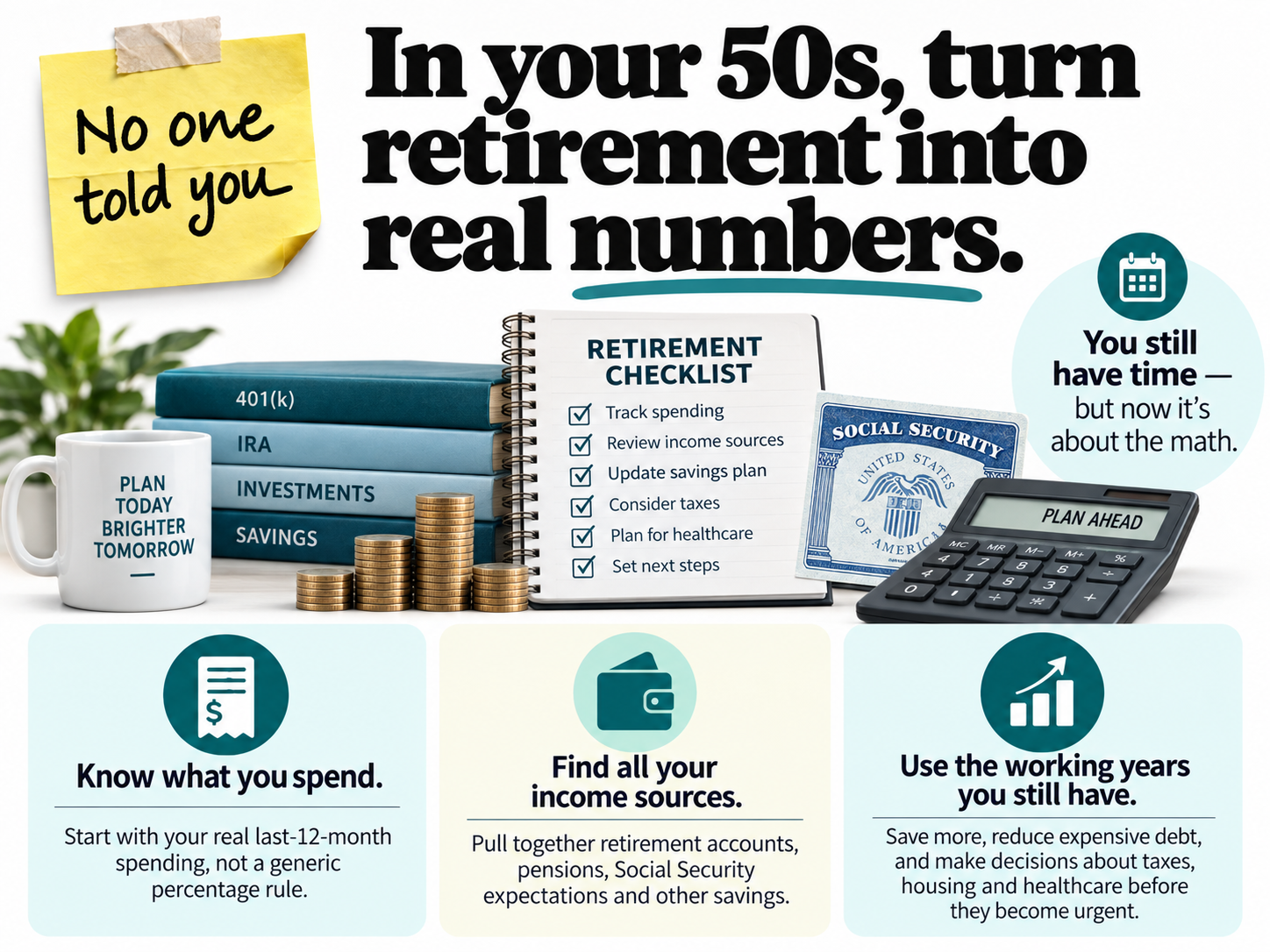
Start turning retirement into real numbers.
Know what you spend now, what you have saved, what Social Security or pension income you expect, and what your biggest retirement expenses will be.
Then use the working years you still have to save more, reduce expensive debt and make decisions about housing, healthcare and taxes before they become urgent.
Updated
The short version
If you are in your 50s, retirement is close enough that "I'll deal with it someday" is no longer a great strategy.
But you still have time.
The goal now is not to learn every retirement rule.
The goal is to answer:
What will my life cost?
What income will I have?
Is there a gap?
Then use the working years you still have to shrink that gap.
Step 1: Figure out what you actually spend
Do not start with a generic rule about what percentage of salary you will need.
Start with your own life.
Look at the last 12 months.
How much did you actually spend?
Step 2: Find all the money you already have
List every:
- 401(k)
- 403(b)
- IRA
- Roth IRA
- pension
- old employer plan
- HSA
- brokerage account
- cash account you expect to use
Get everything onto one page.
Step 3: Look at Social Security now
Sign in to your my Social Security account.
Look at your estimated benefit at different claiming ages.
Check your earnings history too.
Step 4: Save more if you can
For 2026:
normal 401(k) employee contribution limit = $24,500
general age-50+ catch-up = another $8,000
ages 60-63 = up to $11,250 of catch-up in many plans
You do not have to hit the maximum.
Ask:
Can I raise what I am saving now?
Step 5: Look hard at debt and housing
Every monthly bill you carry into retirement has to be paid by retirement income.
Will the mortgage still exist?
Are you carrying expensive debt?
Is the house expensive to insure or maintain?
Would moving actually save money after all the costs?
Step 6: Understand the healthcare bridge
If you want to retire before 65:
How will you get health insurance?
If you retire at or after 65:
What will Medicare actually cost?
Step 7: Look at taxes before retirement, not after
If most of your savings is in traditional retirement accounts, that money generally has taxes attached.
Once the paycheck stops, you may have years when taxable income is lower.
Those years can create opportunities to look at Roth conversions before Social Security and required withdrawals add more income later.
Step 8: Practice the retirement budget
Try living for a few months on what you think your retirement budget will be.
Save the difference.
If the budget feels impossible now, that is useful information.
The bottom line
Turn retirement into four numbers:
- What you spend.
- What you have.
- What income you expect.
- The gap between the two.
Then work the gap while you still have a paycheck.