How Do You Get Health Insurance If You Retire Before 65?
Direct answer
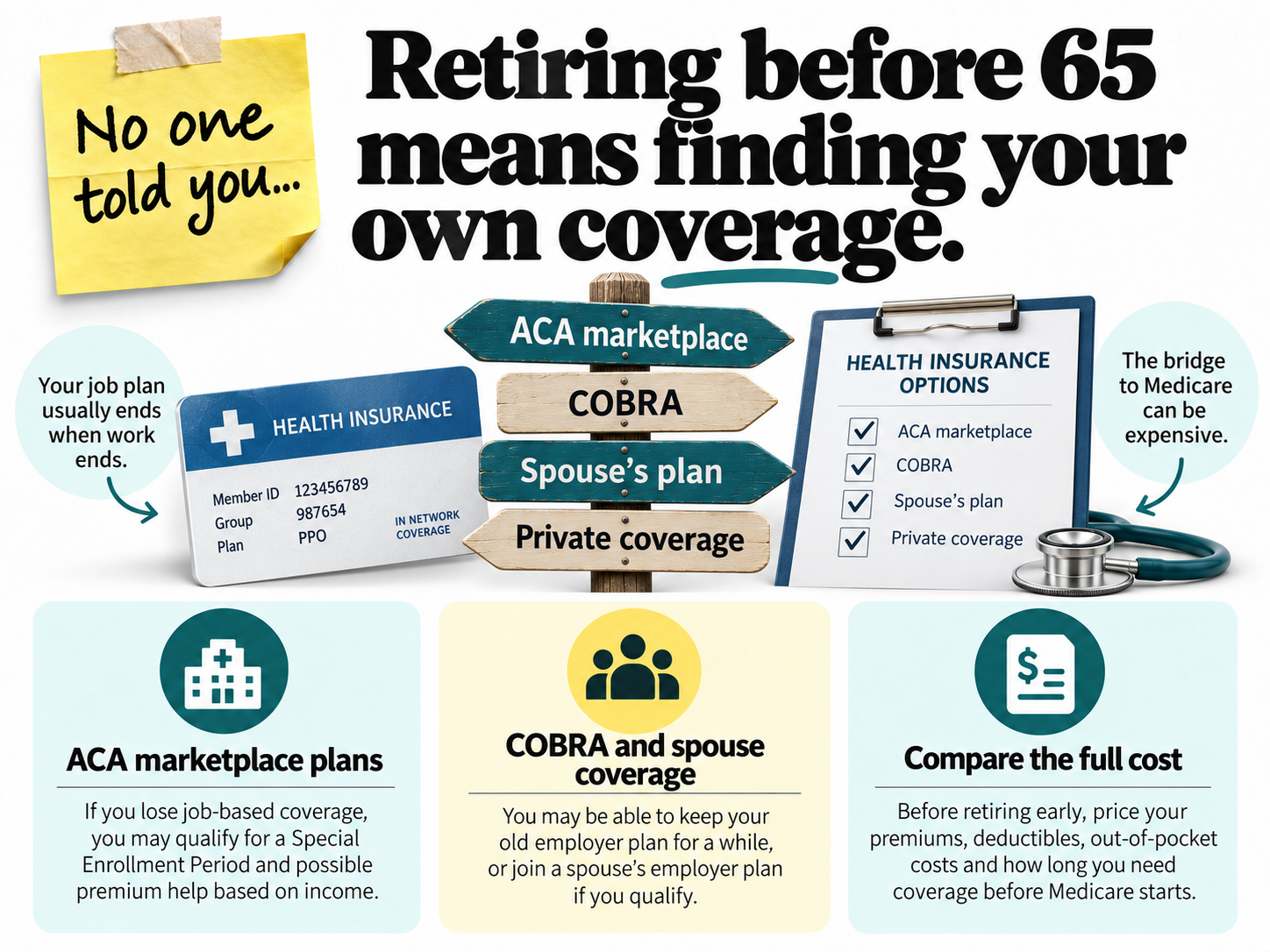
You have options. Depending on your situation, you may use an ACA Marketplace plan, a spouse's employer plan, COBRA or retiree coverage from a former employer. Losing job-based insurance gives you a Marketplace special enrollment period, so you do not have to wait for the normal annual signup window.
Updated
The short version
A lot of people think:
“I can afford to retire at 62, but I need to keep working until 65 for health insurance.”
Sometimes that is true.
Sometimes it is not.
You need to price the alternatives before assuming the job is your only option.
Option 1: ACA Marketplace coverage
If you retire before 65 and lose job-based health insurance, HealthCare.gov says you qualify for a special enrollment period.
You can generally apply from 60 days before to 60 days after losing that coverage.
Depending on your household income, you may qualify for help lowering the premium.
Option 2: A spouse's employer plan
If your spouse is still working, you may be able to join their plan.
Check the actual cost.
The premium to add a spouse can be very different from what your spouse pays for employee-only coverage.
Option 3: COBRA
COBRA may let you continue the same employer coverage for a period after you leave work.
That can be useful if you want to keep the same doctors or are in the middle of treatment.
But you may have to pay the full premium yourself.
The price can be a shock if your employer had been paying a large share while you worked.
Option 4: Retiree health coverage
Some employers still offer retiree medical coverage.
If yours does, understand exactly what it pays, what it costs and how it changes once Medicare begins.
Here is the part people miss: your withdrawals can affect ACA costs
Marketplace assistance is based partly on household income.
Traditional IRA and 401(k) withdrawals generally count as income.
A Roth conversion generally creates taxable income too.
Qualified Roth withdrawals generally do not create taxable income in the same way.
So two retirees who need the same amount of spending money can end up with very different Marketplace income depending on where the money comes from.
Example:
Two people each need $60,000 to live on.
One has cash savings and qualified Roth money.
The other needs to pull most of the $60,000 from a traditional IRA.
Their spending is the same.
Their taxable income may not be.
That can affect both taxes and Marketplace premiums.
The bottom line
Do not make 65 your retirement age automatically just because that is when Medicare starts.
Price the healthcare bridge first.
Then ask:
What coverage would I use?
What would it cost?
And where would the money come from to pay my bills before Medicare starts?