Is Medicare Free?
Direct answer
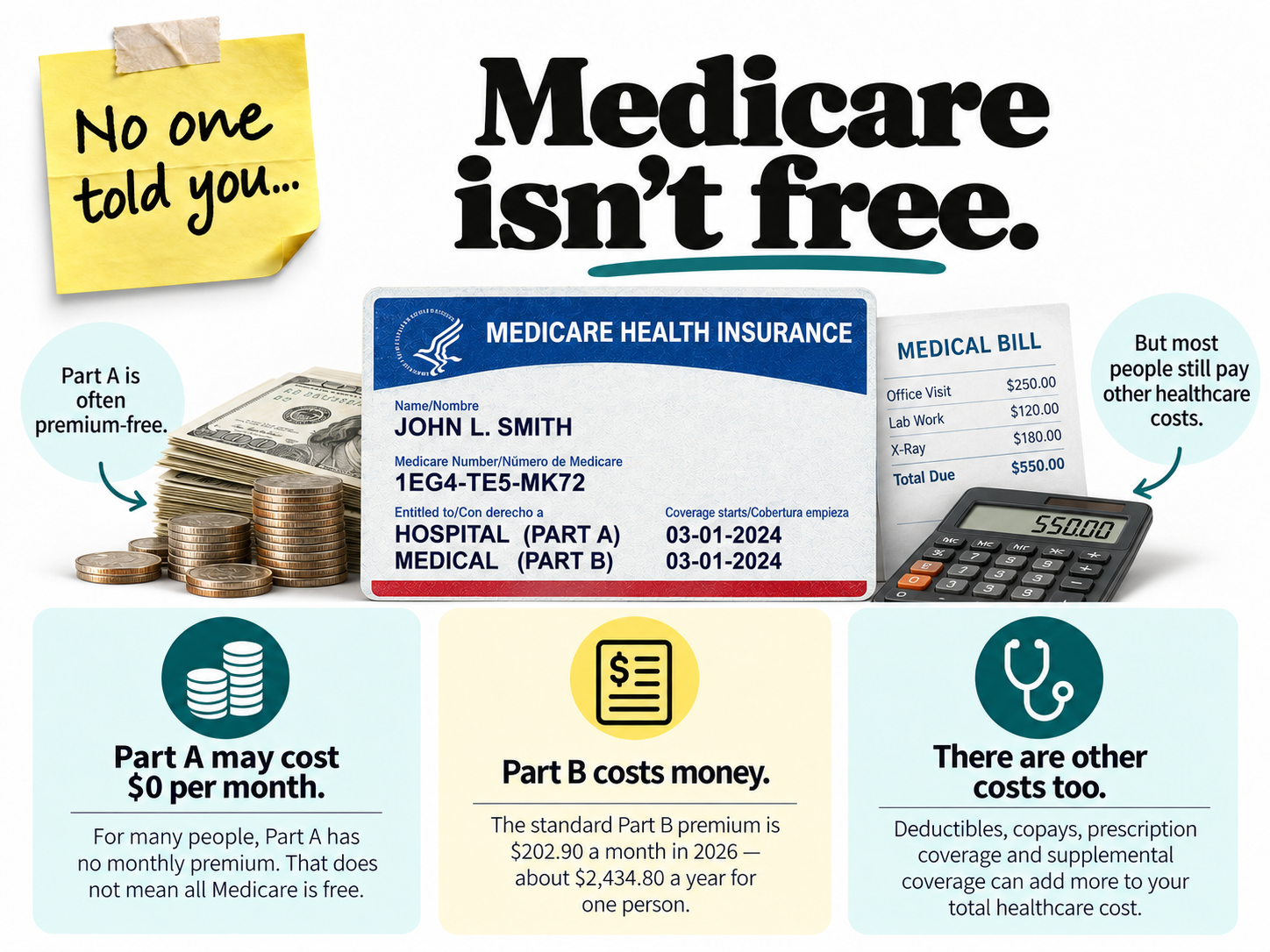
No. Medicare is not free healthcare. Most people pay no monthly premium for Part A, which covers hospital and other inpatient care. But most retirees need more than Part A. Part B has a monthly premium, prescription coverage can cost extra, and you can still have deductibles, copays, coinsurance and other out-of-pocket costs. The standard Part B premium is $202.90 a month in 2026.
Updated
The short version
A lot of us hear:
“Medicare starts at 65.”
And mentally translate that into:
“Healthcare is taken care of at 65.”
Not exactly.
Medicare is health insurance.
It does not make every healthcare bill disappear.
Part A is premium-free for most people
Part A covers hospital and other inpatient care, certain skilled nursing care, hospice and some home health care.
Most people pay $0 a month for Part A because they or a spouse paid Medicare taxes long enough while working.
But $0 monthly premium does not mean $0 healthcare cost.
Part A still has deductibles and other costs when you use it.
Part B costs money every month
Part B covers things like doctor visits and outpatient medical care.
The standard Part B premium is $202.90 a month in 2026.
For one person:
$202.90 × 12 = $2,434.80 a year
For a couple where both people pay the standard Part B premium:
$2,434.80 × 2 = $4,869.60 a year
And that is before prescription coverage, supplemental coverage or other out-of-pocket costs.
You may pay more than the standard Part B premium
Higher-income retirees can pay more for Part B and prescription-drug coverage.
Medicare calls the extra charge IRMAA.
You do not need to memorize that acronym here.
Just know:
A high-income year can make Medicare more expensive later.
Medicare generally looks at tax-return income from two years earlier when deciding whether the extra charge applies.
Prescription coverage can cost extra too
Part A and Part B do not automatically give you complete prescription-drug coverage.
Depending on how you get Medicare, you may have a separate Part D drug-plan premium or receive drug coverage through Medicare Advantage.
We explain the four parts of Medicare separately because the alphabet soup deserves its own article.
And there are still out-of-pocket costs
Depending on your coverage, you can still pay:
- deductibles
- copays
- coinsurance
- prescription costs
- supplemental-insurance premiums
- costs for services Medicare does not cover
What people get wrong
“I will have Medicare at 65, so healthcare will basically be free.”
No.
Part A is premium-free for most people.
Medicare overall is not.
The bottom line
Do not put $0 in the healthcare line of your retirement budget just because you will have Medicare.
Start with the Part B premium.
Then account for prescription coverage, supplemental coverage and the costs Medicare leaves to you.