What Is a Roth Conversion?
Direct answer
A Roth account is a retirement account funded with money that has already been taxed. You paid taxes on that money before you put it in your Roth account. As a result, the money inside the Roth can keep growing tax-free. That means, if you meet the withdrawal requirements, you can cash-out the money in your Roth tax-free. That's why you hear so much about Roth IRAs. The money in it grows tax-free.
A Roth conversion means moving money from a traditional IRA or other pre-tax retirement account into a Roth account. Since that traditional money was not taxed when you put it in, the amount you convert generally becomes taxable income when you remove it from your traditional IRA to put it into a Roth. The tradeoff is that the converted money can then grow inside the Roth, and future withdrawals can be tax-free once the Roth rules are met.
You do not have to convert the whole account. You can convert only part of it.
Why would you want to convert only part of it at a time? So you can keep the taxes you pay at the time of conversion lower than if you converted the entire amount at once.
Ugh. This is getting complicated. Stick with it. All will be explained below.
Updated
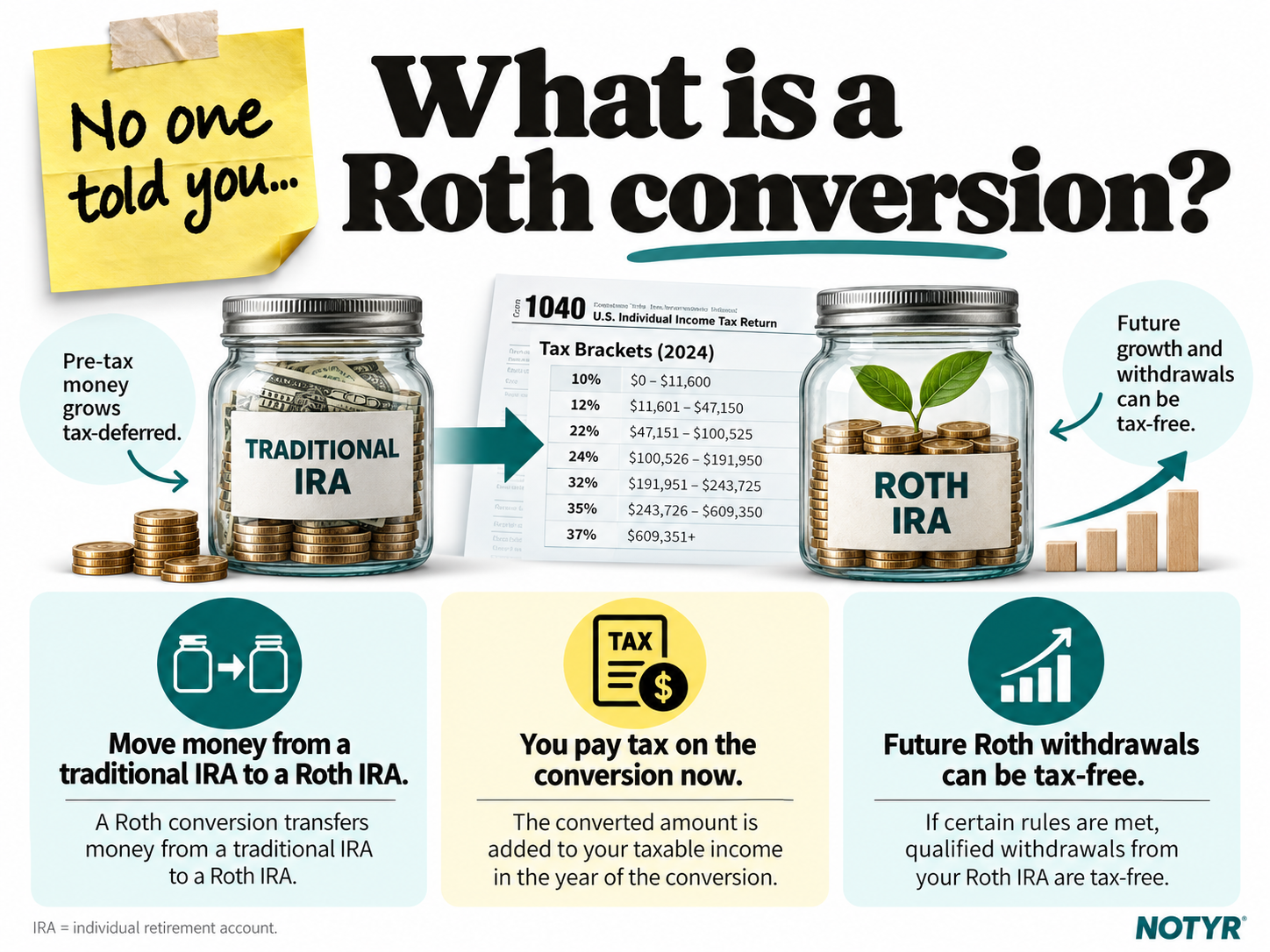
The short version
Traditional retirement money and Roth retirement money are taxed at different times.
Traditional:
You usually got the tax break when the money went in.
The money grows without annual income tax on that growth.
You generally pay income tax when you take the money out.
Roth:
The money you put in has already been taxed.
The money can grow without annual tax on that growth.
Once you meet the Roth withdrawal rules, you can take the money and its growth out tax-free.
A Roth conversion moves money from the traditional bucket into the Roth bucket.
Simple example
Traditional IRA: $500,000
Amount converted: $30,000
Since that money wasn't taxed when you put it into your traditional IRA, the $30,000 you convert generally gets added to your taxable income for that year.
You pay the tax now.
The $30,000 moves into your Roth IRA.
Now that money can keep growing in the Roth, and once you meet the Roth withdrawal rules, future withdrawals can come out tax-free.
Why does the tax-free growth matter?
Say you convert $30,000 and it eventually grows to $60,000.
You paid tax when you converted the original $30,000.
Once the Roth withdrawal rules are met, the additional $30,000 of growth can also come out tax-free.
If that same money had stayed in the traditional IRA, both the original pre-tax money and its growth would generally still be taxable when withdrawn.
That does not automatically make Roth better.
It means the comparison is not just:
tax now vs. tax later
It is also:
how much future growth could happen after I move the money?
Do I have to convert all $500,000?
No.
You can convert part of an IRA.
For example:
$20,000 this year
$30,000 next year
$25,000 the year after that
You do not have to make one giant all-or-nothing decision.
Why would I voluntarily pay tax now?
Because your income may be lower now than it will be later.
Imagine:
While working:
Salary = $180,000
Then you retire.
For a few years:
No salary
No Social Security yet
No required withdrawals yet
Your taxable income may suddenly be much lower.
That can create a window when converting some traditional retirement money may cost less in tax than converting it during a high-income year.
The key word is may.
Why not convert the whole thing?
Because the conversion itself creates income.
Convert $30,000 and you generally add about $30,000 to taxable income.
Convert $300,000 and you generally add about $300,000.
A huge conversion can push some of your income into higher tax brackets and can affect other costs tied to income, including Social Security taxation and Medicare premiums.
I thought I made too much money for a Roth
There are income limits on making a normal annual contribution directly to a Roth IRA.
Those income limits do not stop you from converting traditional IRA money to a Roth IRA.
Those are different rules.
What people get wrong
"Roth conversion means I avoid the tax."
No.
You are usually choosing to pay the tax sooner.
The benefit is that the converted money moves into a Roth, where it can keep growing without annual tax and future withdrawals can be tax-free once the Roth rules are met.
The bottom line
Traditional money:
tax later
Roth conversion:
pay tax now
Roth afterward:
future growth can be tax-free, and withdrawals can be tax-free once the Roth rules are met
The hard part is deciding how much to convert and in which year.