I Was Just Laid Off. What Does That Mean for My Retirement?
Direct answer
First, it means your retirement plan needs to be re-run with less income and possibly an earlier retirement date.
Do not rush to cash out your 401(k).
Protect your cash and health insurance first.
Then look at whether the layoff creates a lower-income tax year, because that can sometimes create opportunities for a Roth conversion or a direct Roth IRA contribution that were not available when your income was higher.
Updated
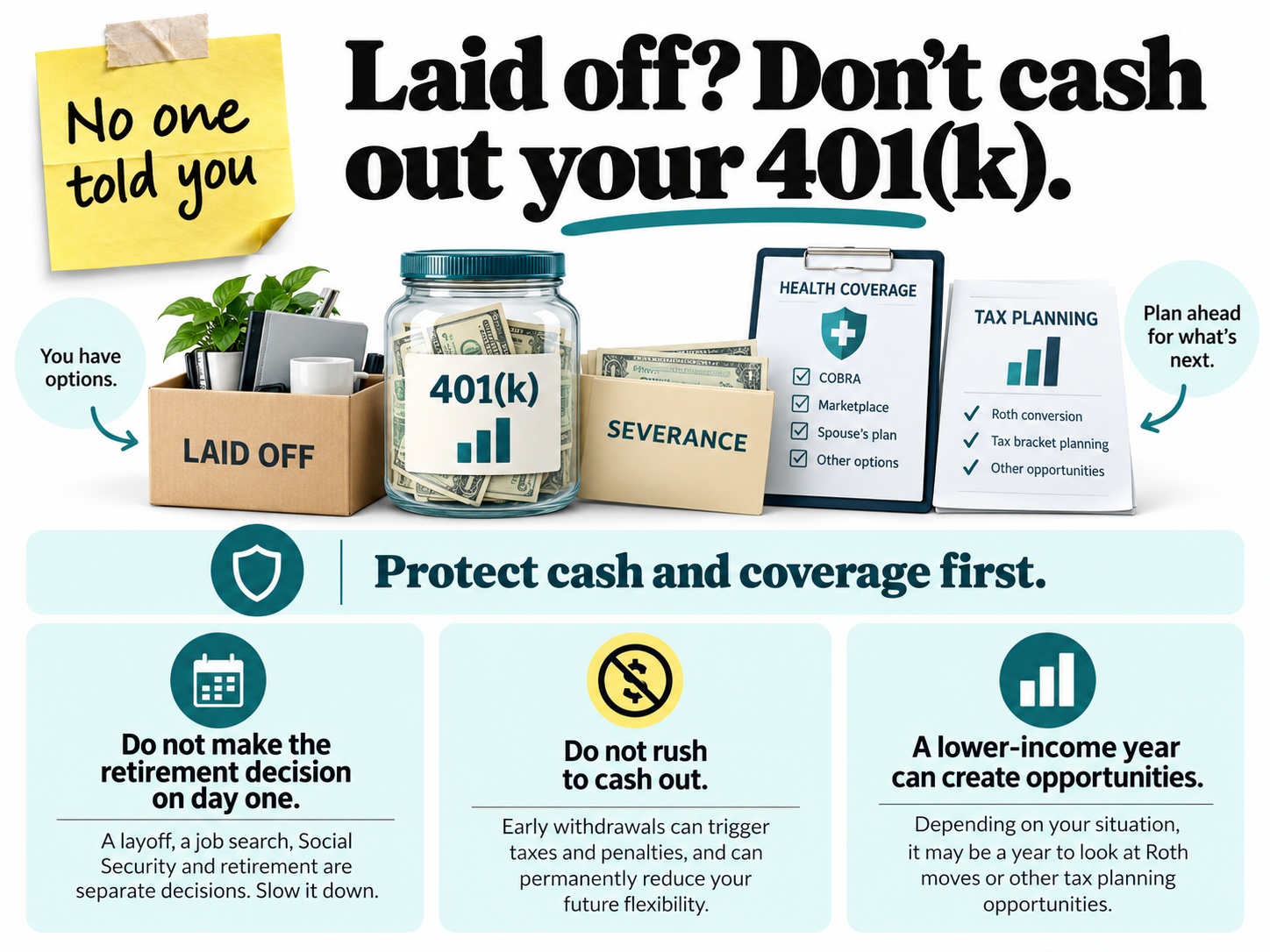
First: do not make the retirement decision on day one
Getting laid off can make it feel like retirement just showed up without asking.
Maybe you planned to work until 65.
Now you are 58, 60 or 62 and suddenly asking:
Do I look for another job?
Can I retire now?
Do I need Social Security?
Do I use the 401(k)?
Those are separate decisions.
Step 1: How long can you cover normal expenses without touching retirement money?
Add up:
- cash
- severance
- unemployment benefits
- spouse income
- other income you know is coming
Then compare that with your monthly expenses.
Step 2: Protect health insurance
If you lost job-based coverage, you generally have a Marketplace Special Enrollment Period.
COBRA may also be available.
A spouse's employer plan may be another option.
Price all of them.
Step 3: Do not automatically cash out the 401(k)
You may be able to:
- leave money in the old employer plan
- roll it into a new employer plan later
- roll it into an IRA
- take some or all as cash
Cashing it out can create income tax and, if you are too young for an exception, an extra early-withdrawal tax.
If you are 55 or older, pause before rolling the old 401(k) into an IRA
If you leave an employer in or after the year you turn 55, withdrawals from that employer's qualifying retirement plan may avoid the extra 10% early-withdrawal tax that normally applies before age 59½.
People call this the Rule of 55.
This only applies if you withdraw money from that employer's plan. It does not apply to an IRA.
Here is the important part:
If you leave your job in or after the year you turn 55, you may be able to take money directly from that employer's 401(k) without the extra 10% early-withdrawal tax that normally applies before age 59½.
If you roll that 401(k) into an IRA first, the Rule of 55 no longer applies to that money. IRA withdrawals before age 59½ follow different rules.
So if you are laid off at 55, 56, 57 or 58 and think you may need some of the money before 59½, do not automatically roll the entire 401(k) into an IRA before you understand your options.
You would still generally owe regular income tax on taxable withdrawals. The Rule of 55 only removes the extra 10% early-withdrawal tax.
Step 4: A layoff can create a lower-income tax year
Suppose you normally earn $180,000.
You are laid off in March.
Your total income for the year may be much lower than normal.
That can create a lower-tax window worth examining for a Roth conversion.
Let's use a simplified example for a single filer in 2026.
Normally, you earn $180,000 for the year.
After the 2026 standard deduction of $16,100, your simplified taxable income would be about $163,900.
Your top dollars would fall in the 24% federal tax bracket.
Now imagine you are laid off at the end of March after earning only $45,000.
For this simple example, assume no severance, unemployment benefits, investment income or other taxable income.
$45,000 of wages
− $16,100 standard deduction
= about $28,900 of taxable income
Your top dollars would now fall in the 12% federal bracket.
In 2026, the 12% bracket for a single filer goes up to $50,400 of taxable income.
That leaves about:
$50,400
− $28,900
= $21,500
of room before the next dollars move into the 22% bracket.
So in this simplified example, you could look at converting roughly $21,500 from a traditional IRA to a Roth IRA while keeping those converted dollars within the 12% bracket.
That does not mean you should automatically convert $21,500.
Severance, unemployment benefits, interest, dividends, capital gains and other income would reduce that room.
The point is that an unexpected low-income year can create a tax window that did not exist while you were earning $180,000.
You may also qualify to contribute directly to a Roth IRA
For 2026, the contribution phases out between:
$153,000 and $168,000 for many single filers
$242,000 and $252,000 for married couples filing jointly
If your income was usually too high, a layoff may put you under the limit.
But you still need taxable compensation to make an IRA contribution.
Step 5: Re-run Social Security
Social Security uses your highest 35 years of earnings.
If you stop working before you have 35 years, zero-earnings years get included.
Even if you already have 35 years, another high-earning year might have replaced an older lower-earning year.
Step 6: Do not let "I was laid off" automatically become "I am retired"
Those are not the same event.
You can look for another job, work part-time, take a break, retire, or combine several of those.
The bottom line
After a layoff:
Protect cash.
Protect health insurance.
Do not rush the 401(k) decision.
Check whether the Rule of 55 matters.
Estimate your full-year income.
See whether a Roth conversion or Roth contribution deserves a look.
Re-run your retirement date.