What Happens to the Taxes I Avoided by Putting Money in a Traditional 401(k)?
Direct answer
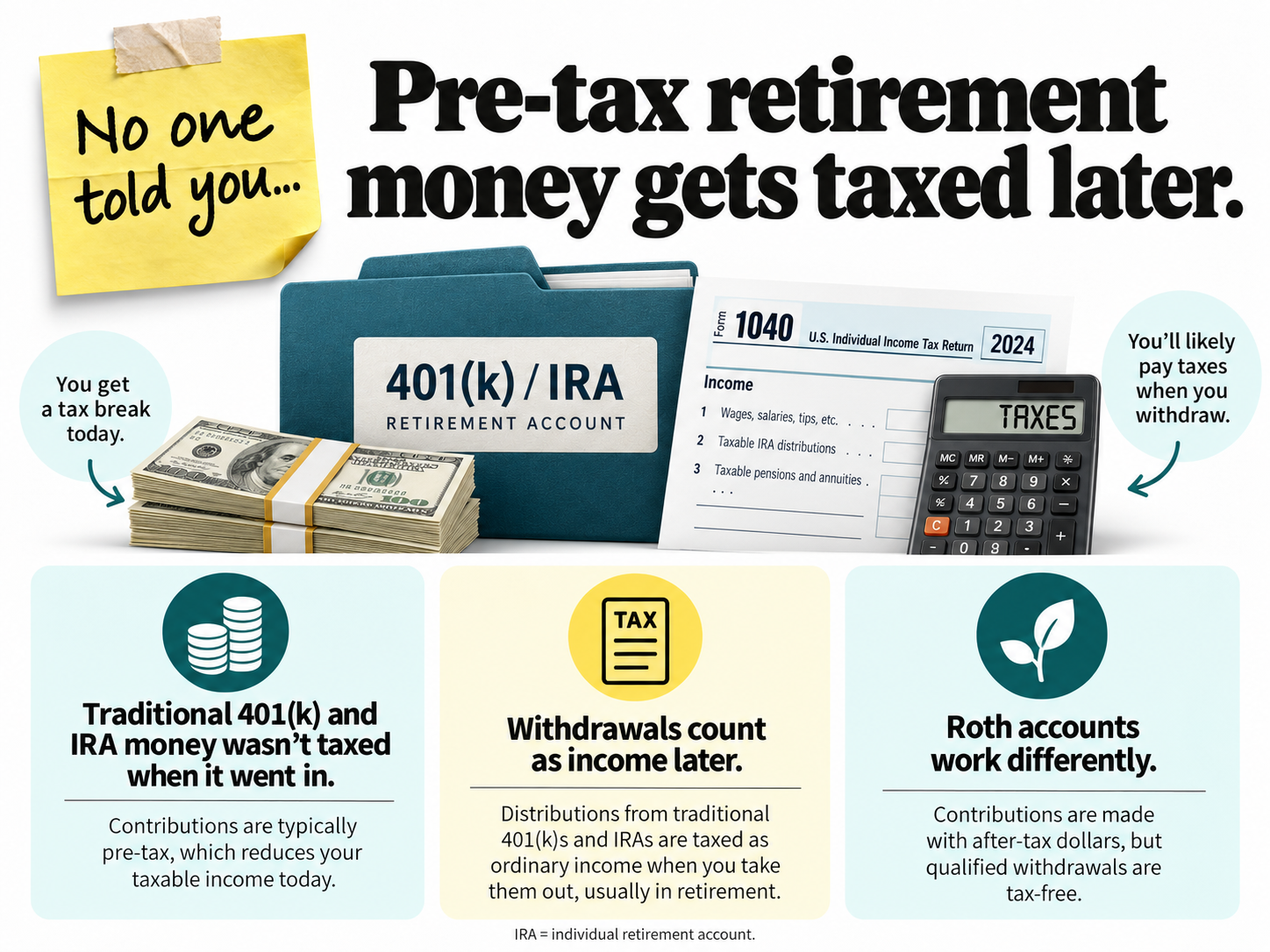
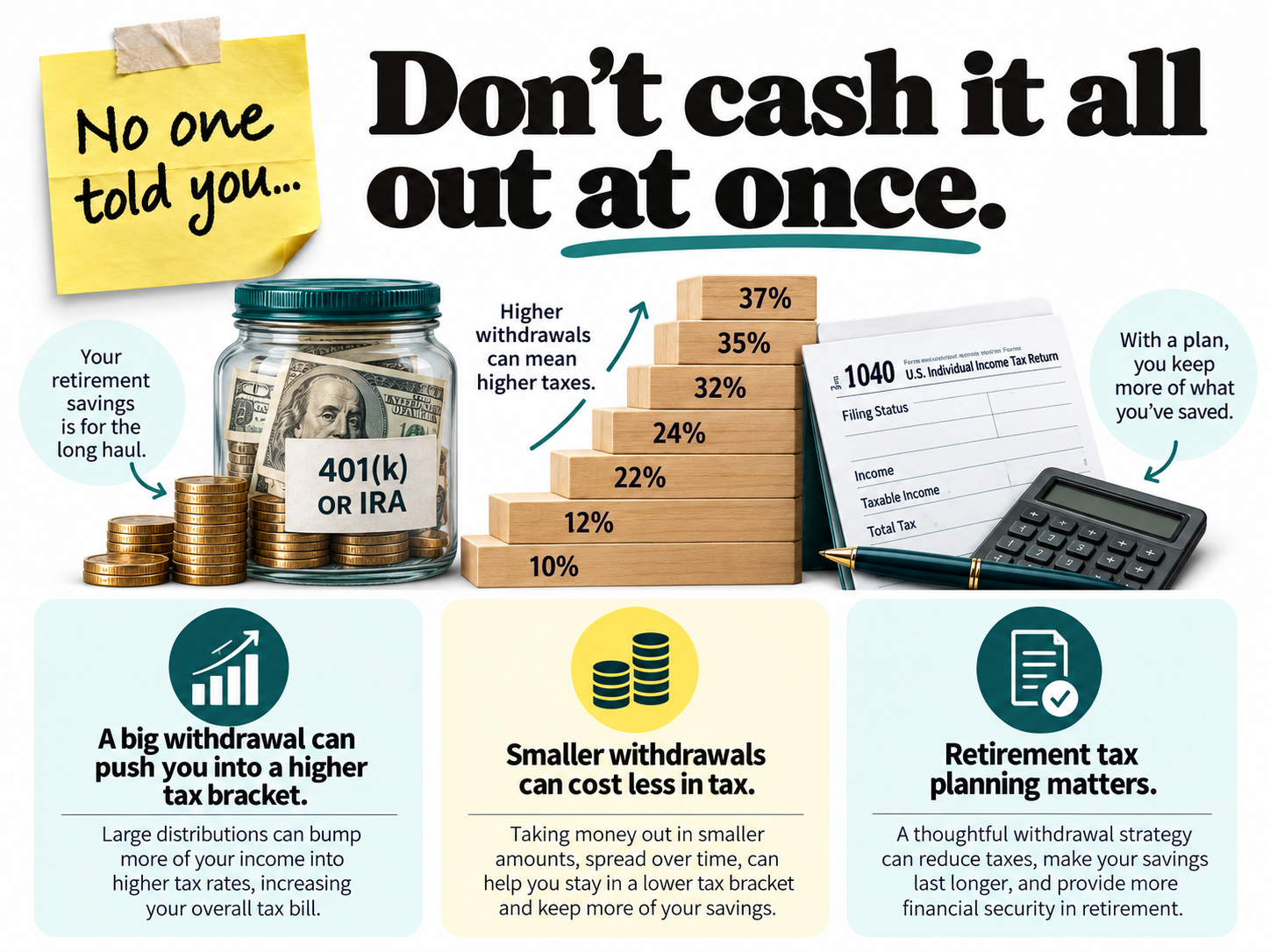
Traditional 401(k) money usually gave you a tax break while you were working. You generally pay income tax when you take that money out in retirement. That means the amount you withdraw in a given year matters. Taking a very large amount all at once can push some of your income into higher tax brackets than spreading withdrawals over several years. Qualified Roth 401(k) withdrawals work differently and can be tax-free.
Updated
The short version
A traditional 401(k) gave you a deal:
Do not pay federal income tax on that money now. Pay it later.
That can be a very good deal.
But “later” eventually arrives.
When you take taxable money out of a traditional 401(k), it generally gets added to your taxable income for that year.
And how much you take out can change your tax result.
Example: the tax break while you are working
Let's use a simplified example.
You are single, age 55, and earn $130,000 in 2026.
You put $27,000 into your traditional 401(k).
That $27,000 is below the 2026 contribution limit for someone age 50 or older.
Without the traditional 401(k) contribution:
Salary: $130,000
2026 standard deduction: −$16,100
Simplified taxable income: $113,900
At $113,900 of taxable income, your top dollars fall in the 24% federal tax bracket in 2026.
Now make the $27,000 traditional 401(k) contribution.
Salary: $130,000
Traditional 401(k): −$27,000
Income before standard deduction: $103,000
Standard deduction: −$16,100
Simplified taxable income: $86,900
At $86,900, your top dollars fall in the 22% bracket.
In this simplified example, the traditional 401(k) contribution lowered the income being taxed today and moved your top dollars into a lower marginal bracket.
Important:
A marginal tax bracket is the rate on your next/top dollars.
It does not mean every dollar of your income is taxed at 22% or 24%.
Fast-forward to retirement
Now imagine you retire at 62.
Your traditional 401(k) has grown to $300,000.
You think:
“I already earned this money. Why would taking it out create a big tax bill?”
Because the tax was postponed.
It was not erased.
What if I take the entire $300,000 out in one year?
Use another simplified example.
Assume:
- you are single
- age 62
- you have no other taxable income that year
- you use the 2026 standard deduction for illustration
$300,000 traditional 401(k) withdrawal
− $16,100 standard deduction
= about $283,900 of taxable income
At that level, your top dollars would land in the 35% federal bracket using the 2026 brackets.
Again:
Not every dollar is taxed at 35%.
Federal income tax is progressive.
But taking the entire account in one year pushes some of the withdrawal into much higher brackets.
Using the 2026 brackets for this simplified illustration, the federal income tax on $283,900 of taxable income would be about $68,134 before credits or other adjustments.
Now compare taking only what you need
Suppose you spend $6,000 a month in retirement.
That is:
$6,000 × 12 = $72,000 a year
Again assume no other taxable income for the simplified example.
$72,000 withdrawal
− $16,100 standard deduction
= about $55,900 taxable income
Your top dollars would fall in the 22% federal bracket instead of reaching the 35% bracket created by taking the entire $300,000 at once.
Using the same simplified 2026 brackets, federal income tax on $55,900 of taxable income would be about $7,010 before credits or other adjustments.
So should I always take smaller withdrawals?
Not automatically.
Real retirees can also have:
- Social Security
- pensions
- investment income
- required withdrawals
- part-time income
- other taxable income
And sometimes you may intentionally choose a larger withdrawal for a specific reason.
The lesson is not:
“Always withdraw exactly $72,000.”
The lesson is:
The year you take traditional 401(k) money out matters.
Why this matters even more once Social Security and Medicare enter the picture
Traditional 401(k) withdrawals can increase your taxable income.
That can also:
- make more of your Social Security taxable
- affect Medicare premiums later
- change other income-based tax rules
So the tax on the withdrawal itself may not be the only effect.
What people get wrong
“I already earned the money, so taking my 401(k) out should not create new taxable income.”
With a traditional 401(k), the tax was generally deferred while you were working.
The withdrawal is when the government finally collects it.
The bottom line
Traditional 401(k):
tax break while you are working
then
taxable income when you take the money out
The account balance is not the same thing as after-tax spendable cash.
And taking $300,000 in one year can create a very different tax result from taking only what you need over several years.