Is Social Security Taxable?
Direct answer
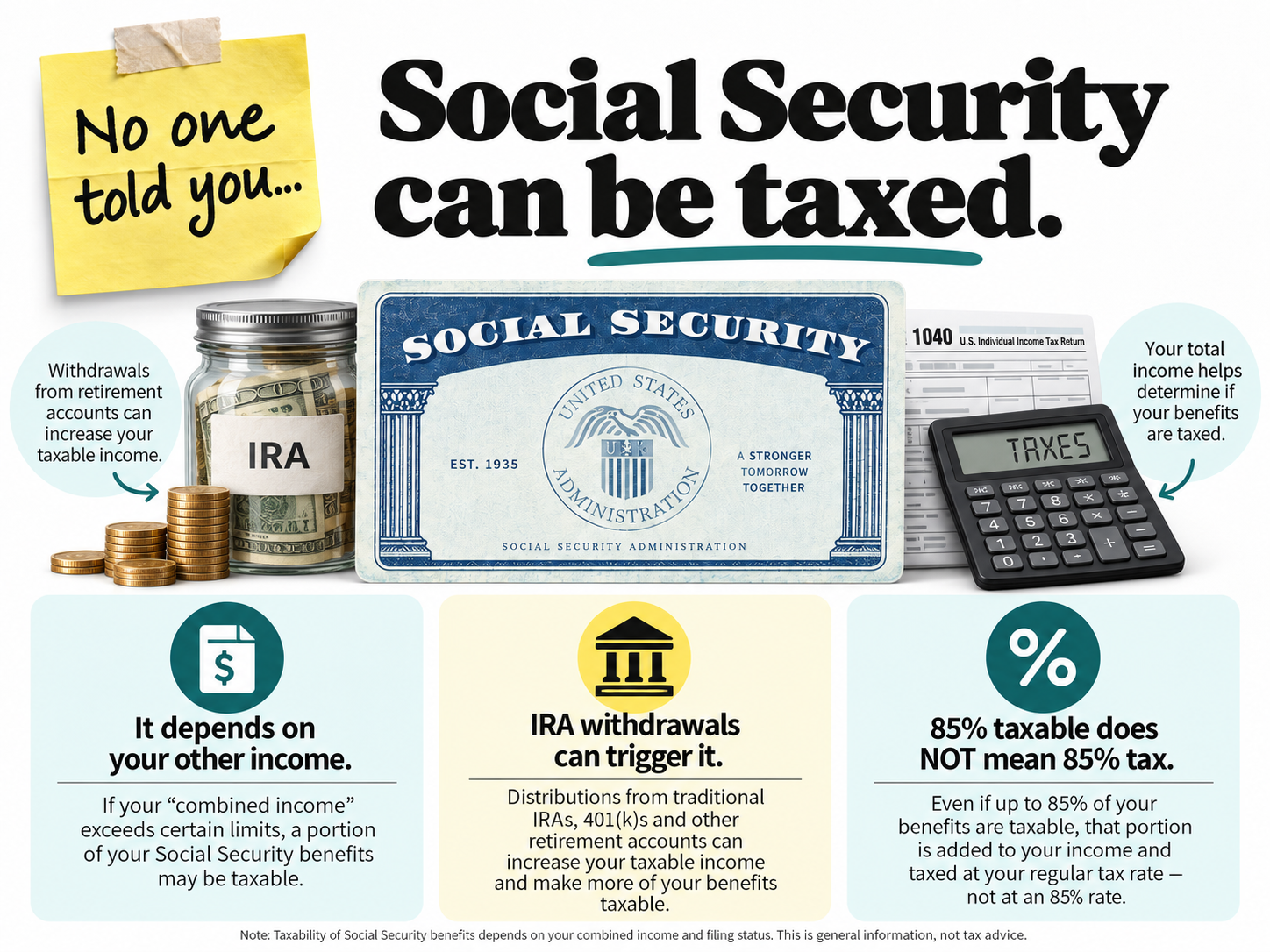
Yes. Social Security can be taxed. The more other income you have from things like a job, pension, traditional IRA or 401(k), interest and investments, the more likely it is that part of your Social Security will be taxable. At most, 85% of your Social Security benefit is included in taxable income. That does not mean you pay an 85% tax rate.
Updated
The short version
A lot of people assume Social Security is tax-free because they already paid Social Security taxes while they were working.
It is not necessarily tax-free.
Once you start collecting Social Security, the government looks at your Social Security together with the rest of your income.
The more other income you have, the more of your Social Security may become taxable.
What does “85% of Social Security is taxable” actually mean?
This is one of the worst explained retirement rules.
It does not mean the government takes 85% of your Social Security check.
It means up to 85% of your Social Security benefit can be included with the rest of your taxable income.
Then your normal income-tax rates apply.
When does Social Security start getting taxed?
The government uses a special income calculation.
You do not need to memorize the formula.
In simple terms, it looks at:
- your other income
- tax-free interest
- half of your Social Security
For many single people, Social Security can begin becoming taxable once that number goes above $25,000.
For married couples filing jointly, it can begin above $32,000.
At higher income levels, up to 85% can become taxable. Those higher thresholds are $34,000 for many single filers and $44,000 for married couples filing jointly.
You do not need to memorize those numbers.
The important thing is:
Other income can cause more of your Social Security to be taxed.
Here is another thing no one tells you:
Those income thresholds do not automatically rise with inflation.
They have been sitting at those levels for decades.
So as incomes and Social Security benefits rise over time, more retirees can get pulled into paying tax on their benefits.
Why your 401(k) or IRA matters
Suppose you need $50,000 from your traditional IRA to live on.
That $50,000 withdrawal is generally taxable income.
It can also cause more of your Social Security to become taxable.
So one withdrawal can create two tax effects:
You owe tax on the IRA withdrawal.
And more of your Social Security may become taxable too.
What about Roth money?
Qualified Roth withdrawals generally do not increase taxable income the same way traditional IRA or 401(k) withdrawals do.
That is one reason having different kinds of retirement accounts can give you more flexibility.
You have more choices about where your spending money comes from.
What people get wrong
“I paid Social Security tax my whole career, so the benefit is tax-free.”
Not necessarily.
Whether Social Security gets taxed depends partly on the rest of the income you have in retirement.
The bottom line
Do not just ask:
“How much Social Security will I get?”
Also ask:
“What other income will I have when I start collecting it?”
Because your IRA withdrawals, pension, job income and investments can change how much of your Social Security gets taxed.
That is the part most people never hear about until they file their first retirement tax return.