Is Social Security Really Running Out of Money?
Direct answer
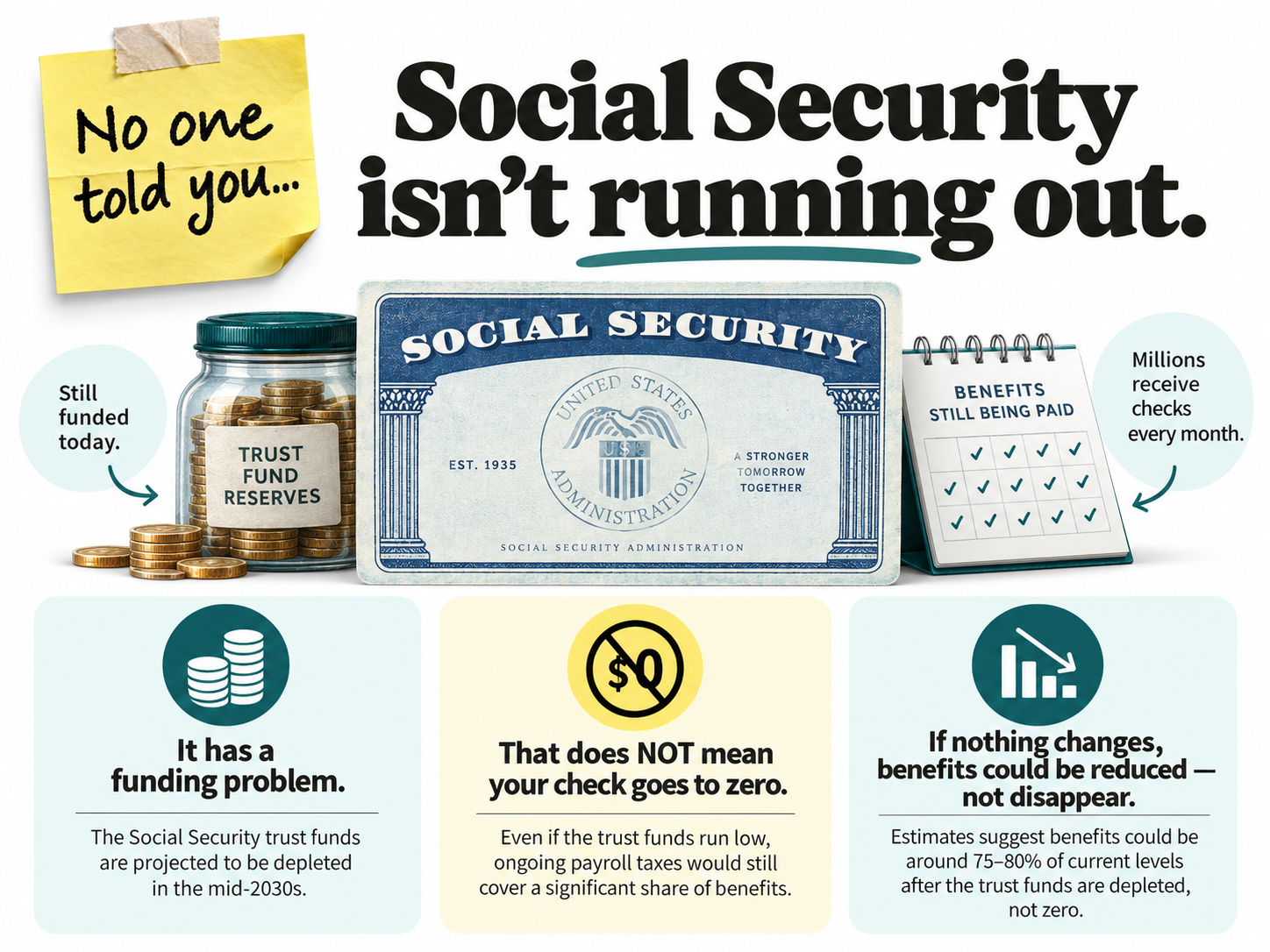
No. Social Security won't suddenly run out of money as long as people are working and payroll taxes are coming in. What could happen, if Congress does nothing to fix the shortfall, is that retirement and survivor benefits would have enough incoming money to pay about 78% of what people are scheduled to receive starting in late 2032. In plain English: benefits could be about 22% lower than scheduled.
Updated
The short version
When people hear that Social Security is “running out of money,” it sounds like the whole program is about to disappear.
It isn’t.
Social Security gets new money every year from workers, employers and self-employed people paying Social Security taxes.
That money keeps coming in as long as people are working.
The problem is that Social Security is expected to pay out more than it collects.
For years, it has also had reserves to make up the difference.
Those reserves are projected to run out for the retirement and survivor program in late 2032.
After that, the money coming in would still be enough to pay about 78% of scheduled benefits under current projections.
So could my Social Security check be cut?
If Congress made no changes before then, yes, current projections say there would not be enough money coming in to pay 100% of scheduled retirement and survivor benefits.
The program would have enough incoming revenue to cover about 78%.
That works out to roughly a 22% shortfall.
That does not mean a 22% cut is definitely going to happen.
Congress has years to change the rules, raise more money, reduce future benefits or use some combination of changes.
Nobody knows today exactly what lawmakers will do.
The important point is:
Social Security has a funding problem.
It is not disappearing.
Where does Social Security's money come from?
Mostly from payroll taxes.
If you are an employee, 6.2% of your wages goes to Social Security and your employer pays another 6.2%.
If you are self-employed, you generally pay both portions.
But here is something a lot of people never hear:
In 2026, Social Security tax only applies to the first $184,500 of earnings.
If someone earns $250,000, the Social Security tax stops after the first $184,500.
The remaining $65,500 is not subject to Social Security payroll tax.
That limit usually rises over time as national wages rise.
Wait. Someone earning $75,000 pays Social Security tax on every dollar, but someone earning $500,000 doesn't?
Correct.
In 2026:
Someone earning $75,000 pays Social Security tax on all $75,000.
Someone earning $184,500 pays it on all $184,500.
Someone earning $500,000 still only pays Social Security tax on the first $184,500.
The other $315,500 is above the Social Security taxable-wage limit.
Medicare tax works differently and does not have the same earnings cap.
That wage cap is one of the things policymakers sometimes discuss when talking about ways to improve Social Security's finances.
Why is Social Security short on money?
The basic problem is pretty straightforward.
More people are collecting benefits.
People are living longer.
And there are fewer workers paying into the system for each person collecting benefits than there were decades ago.
So the money coming in is not keeping up with the money scheduled to go out.
That gap is what the reserves have been helping cover.
Once the reserves are gone, Social Security would largely have to live on the money coming in each year unless Congress changes the system.
What people get wrong
“Social Security is going bankrupt.”
That makes it sound like one day the checks simply stop.
That is not what the projections say.
Even after the reserves are depleted, payroll taxes and other Social Security income would continue coming in.
The problem is that the incoming money would not be enough to pay 100% of scheduled benefits.
Why this matters if you're in your 50s
If you are 55 or 60 today, there are two bad assumptions you could make:
“Social Security will be gone, so I should pretend I’ll get nothing.”
Or:
“Social Security will definitely pay me every dollar currently shown on my statement.”
Neither is a very good planning assumption.
A more realistic way to think about it is:
Social Security is very likely to remain part of retirement income.
But the amount people ultimately receive may depend on changes Congress makes before the reserves run out.
What should you do now?
Start with what Social Security currently says you are scheduled to receive.
Create or sign in to a my Social Security account at SSA.gov.
Look at your estimated monthly benefit at different claiming ages.
Then ask:
How much of my retirement depends on that check?
Would my finances still work if future benefits were somewhat lower?
And how would waiting longer to claim affect the amount I receive?
Those are much more useful questions than:
“Will Social Security still exist?”
The bottom line
Social Security is not about to vanish.
Workers will continue paying Social Security taxes, and that money will continue funding benefits.
The problem is that, under current projections, there will not be enough incoming money to pay every scheduled dollar once the retirement program’s reserves run out in late 2032.
If Congress did nothing, about 78% of scheduled retirement and survivor benefits would be payable at that point.
That is a real problem.
It is not the same thing as Social Security running out of money.