No One Told Me We Don't Keep Both Social Security Checks When One of Us Dies
Direct answer
When one spouse dies, the household generally does not keep both Social Security checks.
If your spouse had the higher benefit, you may qualify for a survivor benefit that raises your monthly payment to as much as the deceased spouse's benefit.
You do not get your old check plus their full check.
You generally end up with the higher benefit.
Updated
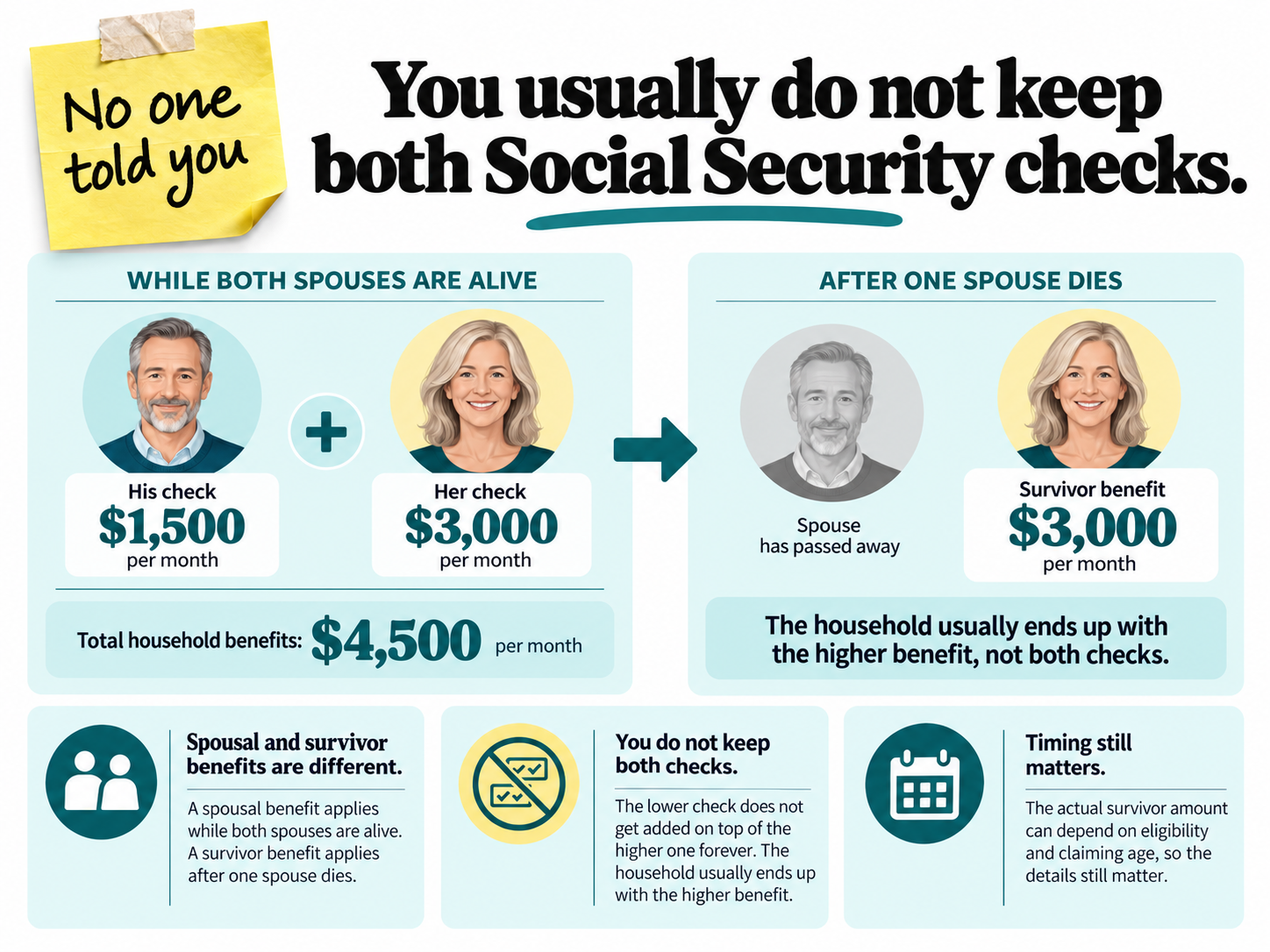
This is different from the spousal benefit
There are two separate spouse rules.
Spousal benefit:
while both spouses are alive, the lower-benefit spouse may qualify for a top-up to as much as half of the other spouse's full-retirement-age benefit.
Survivor benefit:
after one spouse dies, the surviving spouse may be able to step up to as much as the deceased spouse's benefit.
Use the same example
Before your spouse dies:
Your Social Security: $1,500
Your spouse's Social Security: $3,000
Household Social Security: $4,500 a month
Then your spouse dies.
You do not keep:
$1,500 + $3,000 = $4,500
Your spouse's check stops.
If you are old enough to receive the full survivor benefit and otherwise qualify, your total can step up to about $3,000.
Wait. So the household just lost $1,500 a month?
Yes.
That is the part people miss.
The survivor can step up to the larger benefit.
But the household still loses one check.
How much is the survivor benefit?
A surviving spouse can receive from 71.5% up to 100% of the deceased spouse's benefit depending largely on the age when survivor benefits begin.
The amount can reach up to 100% at survivor full retirement age.
Can survivor benefits start before 67?
Yes.
A surviving spouse can generally start survivor benefits as early as age 60.
Starting early can permanently reduce the monthly amount.
Why the higher earner's claiming age matters
If the higher earner waits beyond full retirement age, delayed retirement credits can increase that person's benefit.
That larger benefit can also matter for the survivor later.
The bottom line
While both are alive:
You: $1,500
Spouse: $3,000
Household: $4,500
After the higher-benefit spouse dies:
Survivor: up to about $3,000 if eligible for the full survivor amount
Household: about $3,000
That household-income drop is something couples should know about before it happens.