No One Told Me My Social Security Could Be Increased Because of My Spouse
Direct answer
If your own Social Security benefit is less than half of your spouse’s full-retirement-age benefit, you may qualify for a spousal benefit that increases your total. At your full retirement age, the maximum regular spousal benefit is generally up to half of your spouse’s full-retirement-age amount. You do not get your own check plus another half of your spouse’s check. Social Security adds enough to your own benefit to bring you up to the spousal amount you qualify for.
Updated
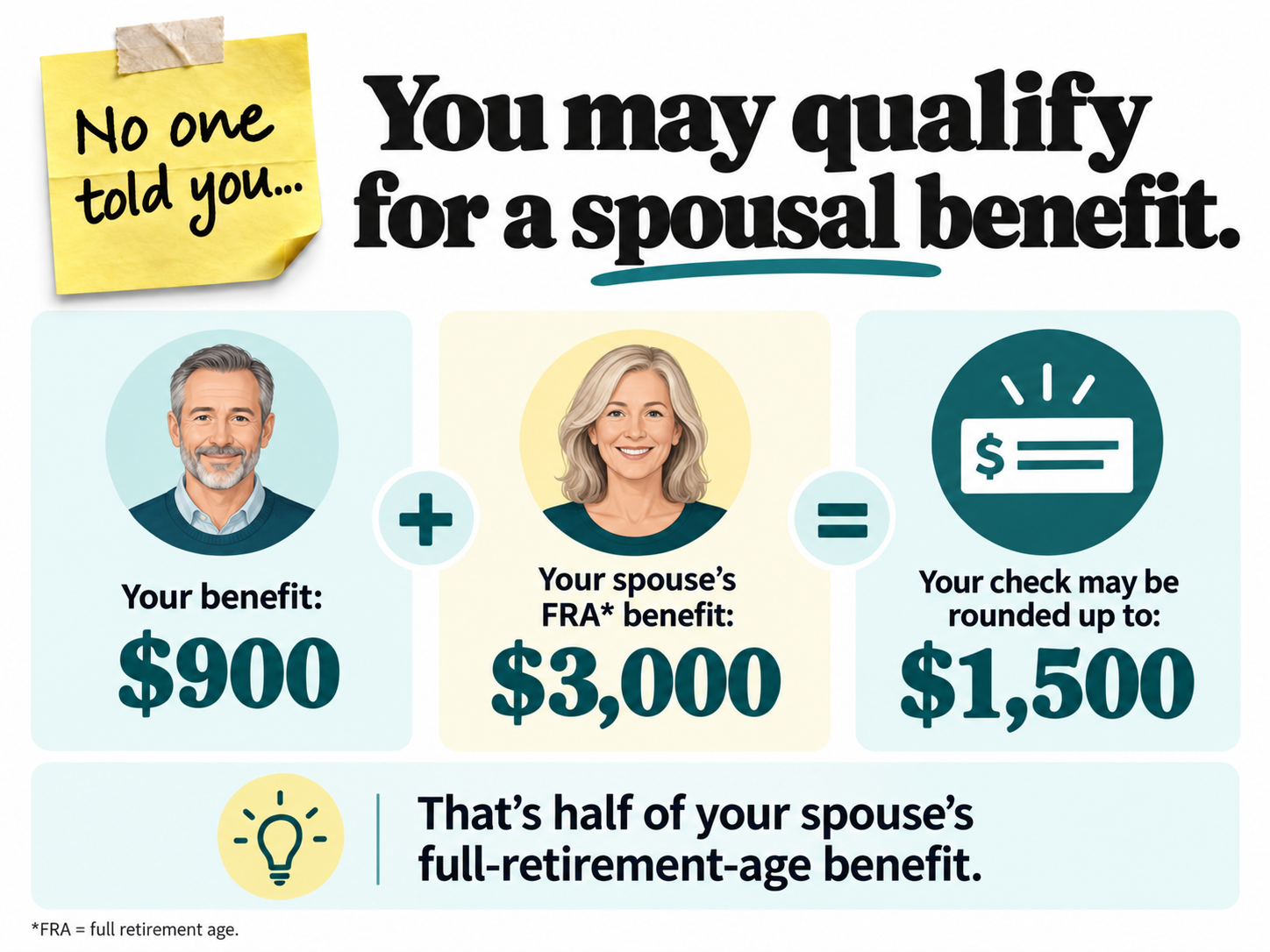
Wait. There is a Social Security benefit just for being a spouse?
Yes.
This is separate from the survivor benefit you may get after a spouse dies.
A spousal benefit can apply while both spouses are alive.
If your own Social Security benefit is smaller than the spousal benefit you qualify for, Social Security can increase your total.
Here is the easiest way to understand it
Say:
Your Social Security benefit: $900
Your spouse’s full-retirement-age benefit: $3,000
You would probably think your total monthly Social Security for the two of you would be:
You: $900
Your spouse: $3,000
Household total: $3,900
You’d be wrong.
If you wait until your full retirement age and qualify for the full spousal benefit, Social Security can increase your $900 benefit to $1,500.
Why $1,500?
Because $1,500 is half of your spouse’s $3,000 full-retirement-age benefit.
So instead of:
You: $900
Your spouse: $3,000
Household total: $3,900
You could get:
You: $1,500
Your spouse: $3,000
Household total: $4,500
That extra $600 is your spousal benefit.
You do not get $900 + $1,500
This is the part that makes the rule sound more complicated than it is.
Social Security pays your own $900 benefit first.
Then it adds $600 from the spousal benefit.
Your total becomes $1,500.
You do not get:
$900 of your own\
- $1,500 from your spouse
= $2,400
The spousal benefit is basically a top-up.
Why do we keep saying “your spouse’s full-retirement-age benefit”?
Because your spouse’s actual check may be different.
If your spouse claims early, their own check may be lower.
If your spouse waits beyond full retirement age, their own check may be higher.
The regular spousal maximum is generally based on the amount your spouse is entitled to at full retirement age.
It is not simply half of whatever check lands in their bank account.
Two catches to know
1. Claiming early can reduce your spousal benefit
If you claim the spousal benefit before your own full retirement age, the amount can be permanently reduced.
For someone born in 1960 or later, full retirement age is 67.
So “up to half” does not mean “half if I claim at 62.”
2. Your spouse generally has to be receiving Social Security first
For a current spouse, the worker generally needs to have filed for retirement or disability benefits before the spouse can receive a spousal benefit on that record.
That matters if the higher earner plans to wait before filing.
This is NOT the survivor benefit
This is the distinction most people never get taught.
There are two different spouse rules:
Spousal benefit: while both spouses are alive, a lower-benefit spouse may qualify for a top-up to as much as half of the other spouse’s full-retirement-age benefit.
Survivor benefit: after one spouse dies, the surviving spouse may be able to step up to as much as the deceased spouse’s benefit.
Those are completely different rules.
We explain survivor benefits separately because they are important enough to deserve their own article.
The bottom line
If your own Social Security benefit is much lower than your spouse’s, do not assume your own work record is the end of the story.
You may qualify for a spousal benefit.
In our example:
Your own benefit: $900
Your spouse’s full-retirement-age benefit: $3,000
Your spousal top-up: $600
Your new total: $1,500
That is an extra $600 a month simply because the spousal-benefit rule exists.