No One Told Me the Government Eventually Makes Me Take Money Out of My Retirement Accounts
Direct answer
After decades of being told not to touch your retirement savings, the rule eventually flips.
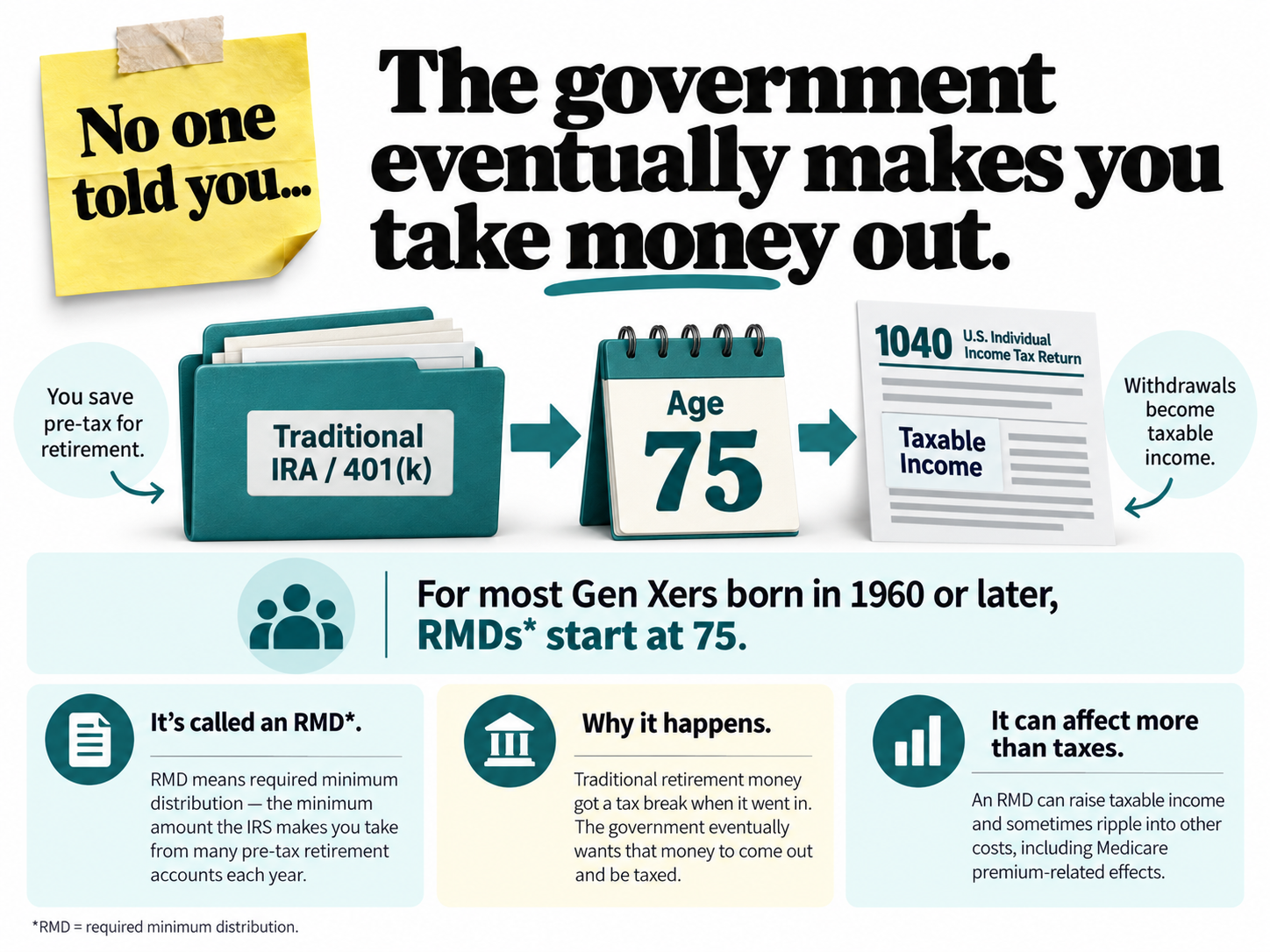
The government requires you to start taking a minimum amount out of many pre-tax retirement accounts every year.
Why?
Because the government let you postpone paying income tax on that money while you were saving it. It eventually wants to collect the tax.
Those forced minimum withdrawals are called Required Minimum Distributions, or RMDs.
Under current law, most Gen Xers born in 1960 or later have to start RMDs at age 75.
Updated
The short version
For years, the advice is:
Put money in the 401(k).
Do not touch it.
Let it grow.
The government gave you a tax break while you were doing that.
Then eventually it says:
You have postponed these taxes long enough.
Start taking some money out so it can finally be taxed.
That required withdrawal is called an RMD.
Why does the government force me to take it?
Because much of the money in traditional IRAs and traditional workplace retirement accounts has never been taxed as income.
You got the tax break while you were working.
The money then grew inside the account without annual income tax on that growth.
The government did not give up the tax forever.
It postponed it.
RMDs are one way the government eventually forces some of that pre-tax money out so income tax can finally be collected.
When do RMDs start?
Under current law, most Gen Xers born in 1960 or later are on the age-75 schedule.
Think: 75.
But Congress has changed this rule before, so recheck it when you get closer.
Which accounts are we talking about?
The rule generally applies to pre-tax retirement money such as:
- traditional IRAs
- traditional 401(k)s
- 403(b)s
- many other employer retirement plans
Roth accounts work differently.
How much does the government make me take?
The amount depends mainly on:
how much is in the account
and
your age
You can take more than the minimum.
RMD means minimum, not maximum.
Is an RMD bad?
Not automatically.
Suppose you need $60,000 a year from your IRA and your RMD is $25,000.
You were already going to withdraw more than the minimum.
Now imagine you have enough Social Security, pension income and cash to cover your expenses.
You do not need anything from the IRA.
But your RMD is $25,000.
Now the government is forcing taxable income onto your tax return even though you did not need the money.
That is where the rule can become annoying because the extra income can trigger higher taxes on other income and higher Medicare premiums.
Wait, what? They're forcing me to take money out, and that will trigger paying more for other things?
Yes.
This is the retirement domino effect.
A pre-tax RMD generally increases your taxable income.
That one increase can affect several other things.
Domino #1: More of your Social Security can become taxable
Social Security taxation depends partly on your other income.
An RMD adds income.
That can cause more of your Social Security to become taxable too.
Domino #2: Your Medicare premiums can go up later
Medicare charges higher Part B and Part D premiums to some higher-income retirees.
This is called IRMAA.
It is not a fine or penalty.
It is a higher premium based on income.
Medicare generally looks at your tax return from two years earlier.
So a large RMD can push income high enough that you pay more for Medicare later.
Using 2026 as an illustration, the first higher-income tier begins above $109,000 for an individual or $218,000 for a married couple filing jointly.
Those thresholds change over time.
Domino #3: Some of your income can move into a higher tax bracket
If an RMD lands on top of Social Security, pension and other income, some of those additional dollars can fall into a higher tax bracket.
That does not mean every dollar suddenly gets taxed at the higher rate.
It means the top part of your income can become more expensive.
Simple domino example
Imagine you are single and already have income from Social Security, a pension and investments.
Without an RMD, your income is close to an income line that can raise Medicare premiums.
Then a $25,000 RMD lands on top.
Now:
the $25,000 itself is generally taxable
more of your Social Security may become taxable
some of your top income may move into a higher tax bracket
and your Medicare Part B and Part D premiums may be higher later if your income crosses the applicable Medicare threshold
One forced withdrawal can create several downstream effects.
What if I do not need the money?
You still have to take it.
But you do not have to spend it.
After taxes, you can save it, invest it in a regular taxable account, give it away or use it later.
Why do Roth conversions come up here?
Because a Roth conversion can reduce how much money remains in traditional retirement accounts.
Less traditional money later can mean smaller future RMDs.
But the conversion creates taxable income now.
So the question becomes:
Would I rather pay some tax earlier when I control the amount?
Or leave the money traditional and potentially have larger forced taxable withdrawals later?
The bottom line
For most Gen Xers, age 75 is when the government eventually starts saying:
You have to take some of this money out now.
Why?
Because it let you postpone the taxes for decades and now it wants to collect them.
And the surprise is not only the tax on the RMD.
That extra income can also affect Social Security taxes, Medicare premiums and your tax bracket.