I'm in My 40s. Why Should I Worry About Retirement Now?
Direct answer
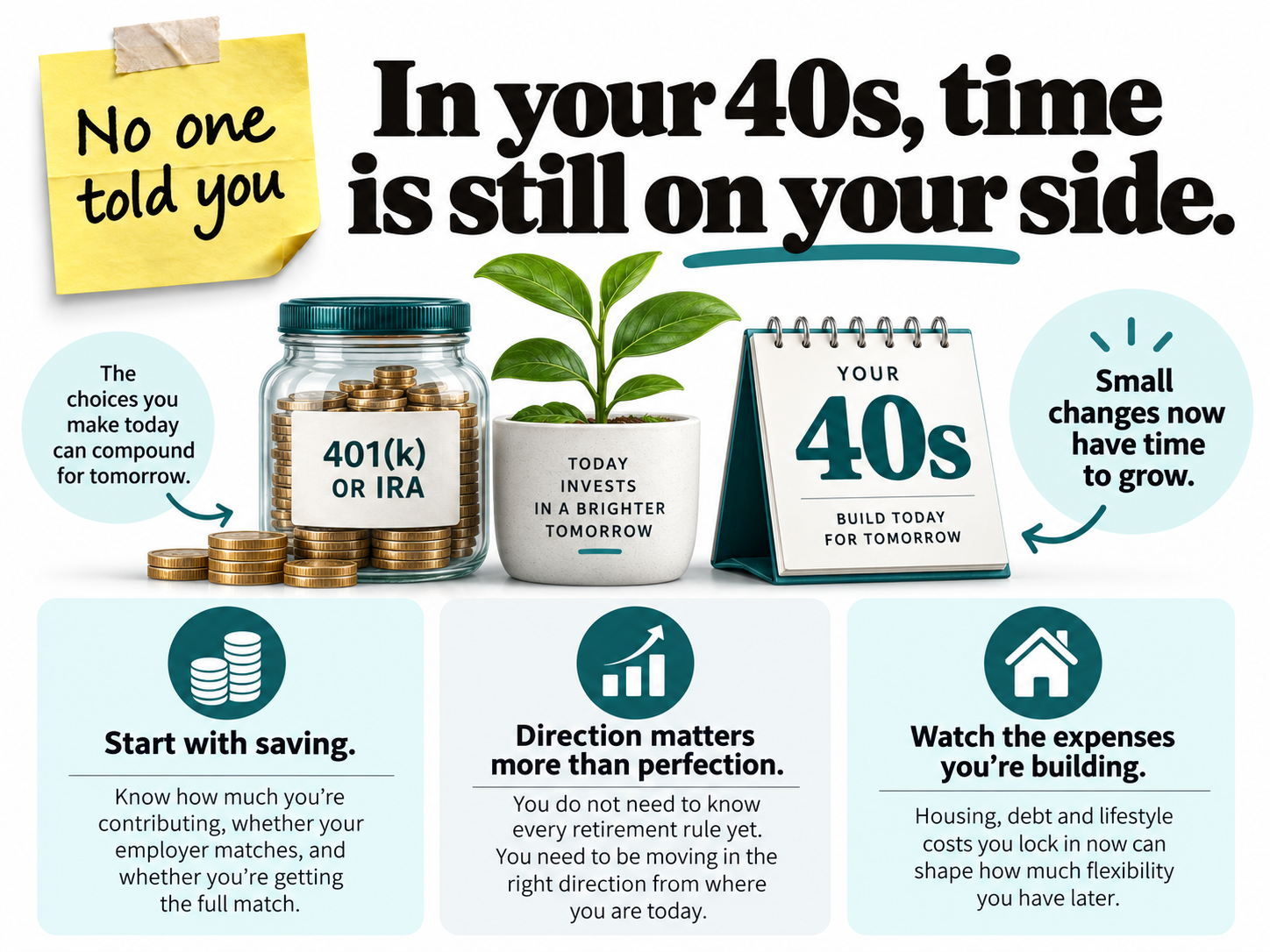
Because time is still on your side. In your 40s, you usually have enough working years left for small changes to add up, which is much easier than trying to make huge changes in your late 50s or 60s. You do not need to know every retirement rule yet. You need to save consistently, know what you already have and keep future expenses from getting out of control.
Updated
The short version
Retirement can feel absurdly far away in your 40s.
You may still be paying for kids, a house, student loans, aging parents, car payments and normal life.
So why worry about retirement now?
Because this is one of the last decades where time can still do a lot of the work for you.
You do not need to know Medicare rules.
You do not need to understand required withdrawals.
You do not need a 40-page retirement plan.
You need to make sure future-you is getting some money every month.
Start with the obvious: are you actually saving?
If your employer offers a 401(k) or similar plan, start there.
At minimum, know:
- how much you are contributing
- whether your employer matches
- whether you are getting the full match
- where the money is invested
If you get a raise, consider increasing your retirement contribution before you get used to spending all of the raise.
Even a one-percentage-point increase matters when it stays in place for years.
Do not obsess over “How much should I have by 40?”
You will see rules like:
“You should have X times your salary saved by age 40.”
Those can be useful benchmarks.
They can also make people shut down.
Your salary, career path, kids, divorce, housing market, pension and job history are not the same as everyone else's.
A better first question is:
Am I moving in the right direction from where I am today?
If the answer is no, fix the direction.
Pay attention to the expenses you are building
Retirement is not just about how much money you save.
It is also about how much money future-you will need every month.
A bigger house.
More expensive cars.
High-interest debt.
Subscriptions and recurring costs.
Those all become part of the number your retirement income eventually has to cover.
The more expensive your life becomes, the more savings you need to support it later.
Do not raid retirement every time life gets messy
A job change can make an old 401(k) feel like found money.
It is not.
Taking money out early means losing both the money and the future growth it could have earned.
Sometimes people genuinely need the money.
But “I changed jobs” by itself is not a reason to cash out a retirement account.
What should I actually do in my 40s?
You do not need 30 tasks.
Start with these:
- Find every retirement account you already have.
- Know what percentage of your pay is going into retirement.
- Get the full employer match if one is available and you can afford it.
- Increase the percentage when income rises.
- Pay down expensive debt.
- Keep an emergency fund so every crisis does not become a retirement withdrawal.
- Make sure your money is actually invested, not sitting in cash by accident.
- Check your beneficiaries.
- Look at your Social Security earnings record once in a while.
- Avoid making your future monthly expenses harder than they need to be.
The bottom line
Your 40s are not the decade to master retirement.
They are the decade to make sure you do not arrive in your 50s saying:
“I wish I had started ten years ago.”
Small changes still have time to matter.
That is the advantage.
One thing I will change this year:
No score.
No "you are behind."
The goal is simply to find the next useful action.