Retirement Feels Overwhelming. Where Do I Even Start?
Direct answer
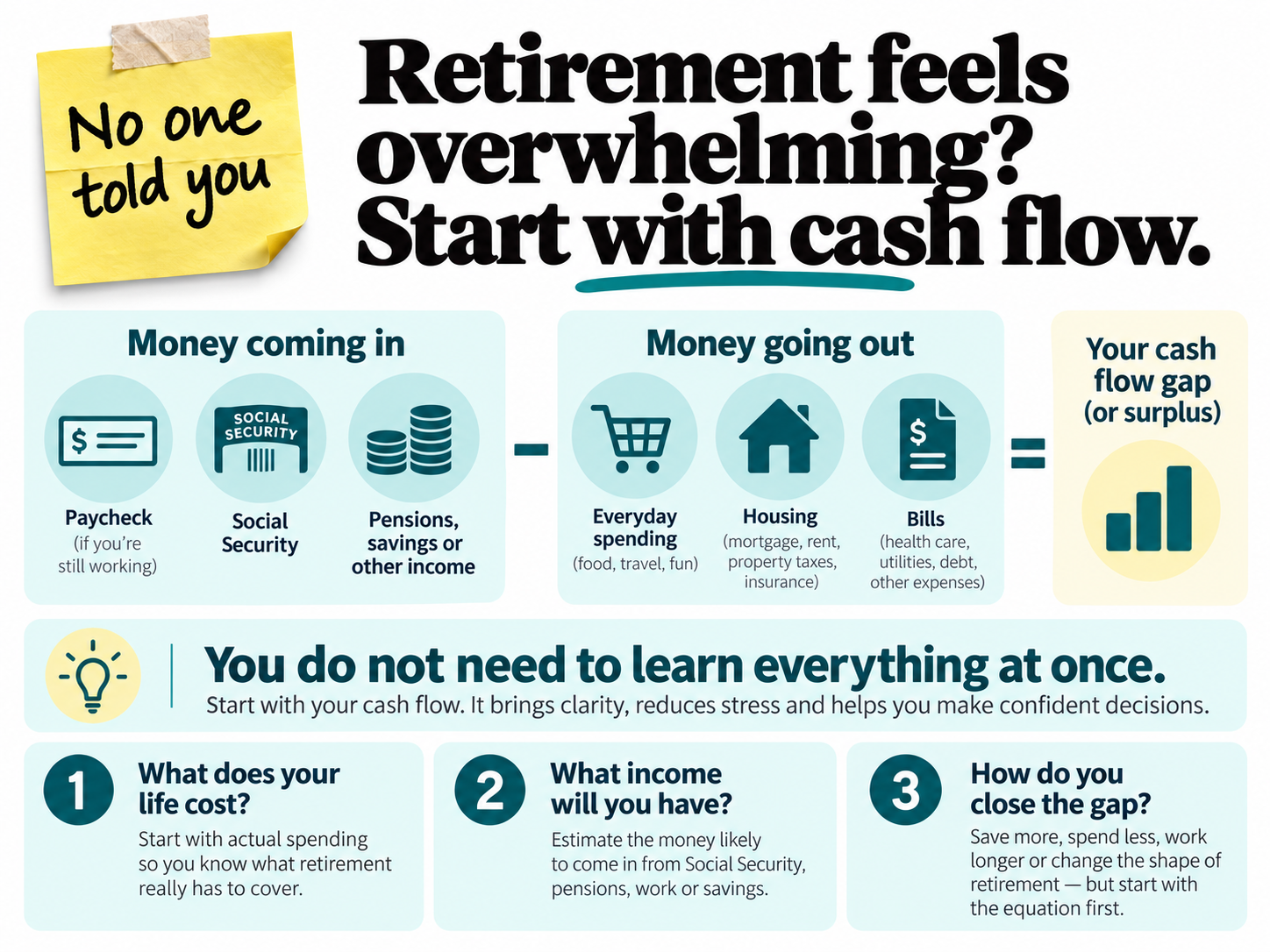
Start with one simple equation:
money coming in vs. money going out.
Retirement is mostly a cash-flow problem.
You do not need to learn Medicare, Social Security, Roth conversions, RMDs and long-term care all at once.
First figure out what your life costs, what income you are likely to have, and what you can do now to save more and lower the expenses you will carry into retirement.
Updated
Forget the acronyms for a minute
Medicare.
RMD.
IRMAA.
Roth conversion.
Spousal benefits.
Long-term care.
Tax brackets.
It can feel like somebody handed you a 300-page manual five minutes before the test.
So do not start there.
Start with:
When the paycheck stops, will the money coming in cover the money going out?
Step 1: What does your life actually cost?
Look at your real spending. Include everything:
- housing — mortgage or rent
- property taxes
- utilities
- groceries
- restaurants
- cars, gas and transportation
- homeowners or renters insurance
- car insurance
- health insurance and medical costs
- debt payments
- taxes
- travel
- hobbies and entertainment
- subscriptions
- pets
- family support
- home maintenance and repairs
- large irregular expenses like replacing a car, roof or HVAC system
Do not worry yet about deciding which expenses will disappear in retirement.
First figure out what your life actually costs today.
Step 2: Which expenses will still exist after you stop working?
Ask:
What expenses am I going to be stuck paying every month?
Step 3: What money will come in?
List:
- Social Security
- pension
- retirement-account withdrawals
- part-time work
- rental income
- other savings
Step 4: Look at the gap
If money coming in is more than money going out, that is one problem.
If money going out is much higher, that is a different problem.
There are really two big levers while you are still working
Lever 1:
Put more money away.
Lever 2:
Lower the expenses future-you will have to support.
A permanent $500-a-month expense is $6,000 a year your retirement income has to produce.
Your first retirement exercise
Write four numbers:
- What I spend each month now.
- What I expect to spend each month in retirement.
- What monthly income I expect without a paycheck.
- What I have already saved.
The bottom line
Retirement planning is not really about learning every rule.
It is about building a life where the money coming in can support the money going out.
While you still have a paycheck:
Save more.
Need less.
Then learn the retirement rules that help you do those two things better.