What Is Medicare Part D, and Why Will I Be Charged a Penalty If I Miss the Enrollment Deadline?
Direct answer
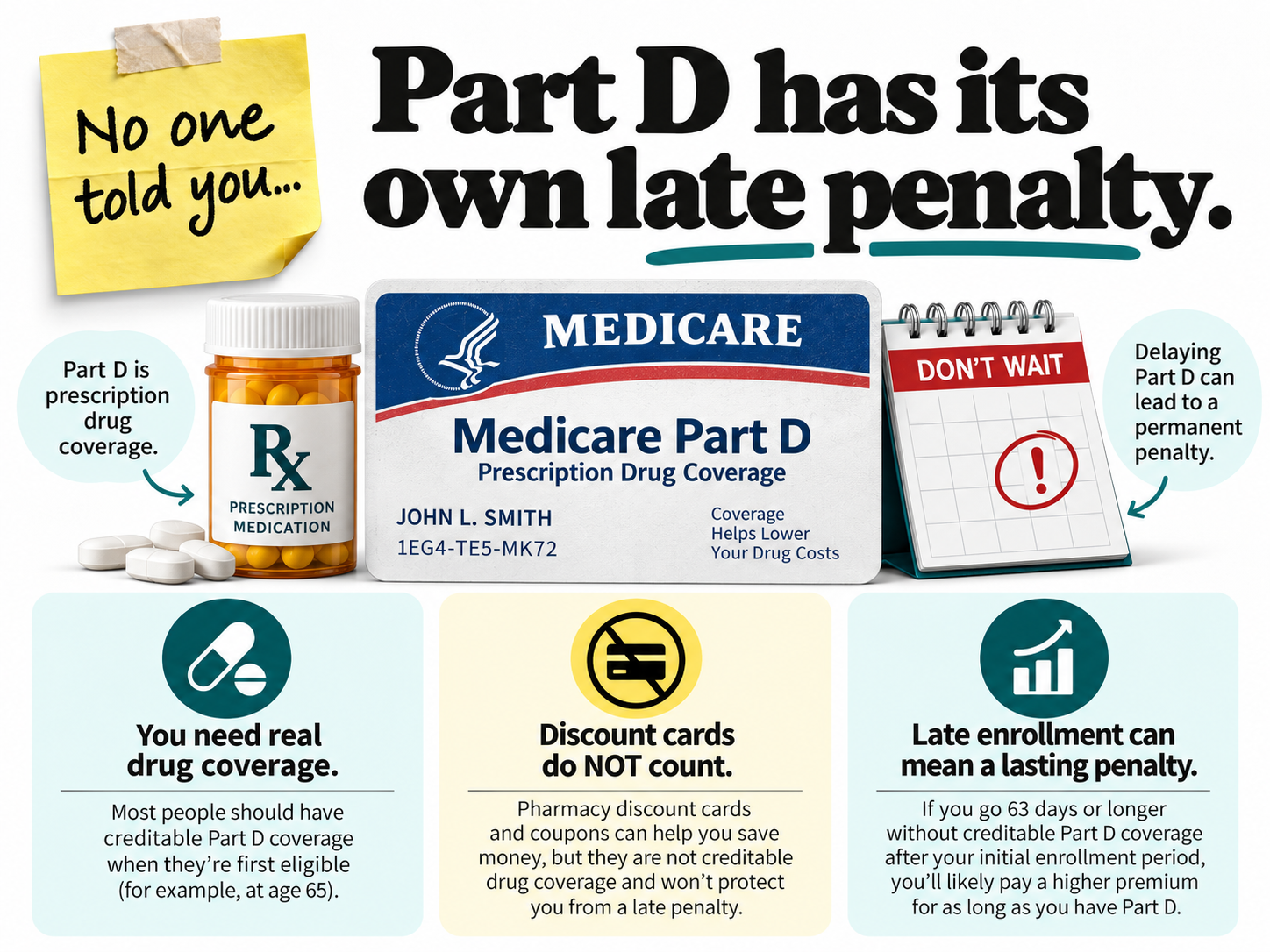
Medicare Part D is prescription-drug insurance. You do not have to buy Part D, but if you go 63 days or more without Part D or other qualifying prescription-drug coverage after you become eligible, Medicare can charge you a late-enrollment penalty when you eventually sign up. A pharmacy discount card, coupon program or drug-discount website does not count as prescription-drug insurance.
Updated
What exactly is Part D?
Part D is Medicare insurance for prescription drugs.
If you use Original Medicare, you can buy a separate Part D plan from a private insurance company that follows Medicare rules.
If you use Medicare Advantage, most plans already include Part D drug coverage.
Do I have to buy Part D?
No.
Part D is optional.
But “optional” does not mean there is no consequence for skipping it.
If you do not enroll in Part D, Medicare expects you to have other prescription-drug coverage that is good enough to take its place.
Medicare calls that creditable coverage.
In normal English:
It has to be actual prescription-drug insurance that Medicare considers at least as good as standard Part D coverage.
What kinds of drug coverage can count?
Examples can include qualifying prescription-drug coverage through:
- a current or former employer
- a union
- TRICARE
- Veterans Affairs
- the Indian Health Service
Do not assume yours counts.
The plan should tell you whether its prescription coverage is creditable.
Keep that notice.
What does NOT count?
This is the part people miss.
A way to get cheaper prescriptions is not necessarily prescription-drug insurance.
Examples that do not count as creditable drug coverage include:
- prescription discount cards
- pharmacy coupon programs
- drug-discount websites
- free clinics
- medication samples from a doctor's office
These programs may save you money.
They do not protect you from the Part D late-enrollment rule.
Cheaper prescriptions ≠ prescription-drug insurance.
Why does 63 days matter?
If you go 63 days or more in a row without either:
Part D
or
other creditable prescription-drug coverage
you can trigger the late-enrollment penalty.
That is why the 63-day number matters.
How much is the penalty?
Medicare generally adds 1% for every full month you went without qualifying drug coverage.
So:
12 full uncovered months = about 12%
24 full uncovered months = about 24%
The percentage is applied to Medicare's national base beneficiary premium, not simply to the premium of whatever plan you later buy.
That base amount can change from year to year.
You do not need to memorize the formula.
The beginner lesson is:
The longer you go without qualifying drug coverage, the bigger the penalty can become.
Is it a one-time fine?
No.
The penalty is generally added to your Part D premium for as long as you have Medicare drug coverage.
So an enrollment mistake can follow you for years.
What people get wrong
“I use a pharmacy discount program, so I have prescription coverage.”
No.
A discount program can reduce the cash price you pay.
It is not the same thing as prescription-drug insurance.
The bottom line
Part D is prescription-drug insurance.
You can skip it if you have other qualifying prescription-drug coverage.
But a coupon, discount card or pharmacy savings program is not a substitute.
If you remember one thing:
It has to be actual qualifying prescription-drug coverage, not just a way to pay less for prescriptions.